NMP Recovery from Cathode Coating
Recovery and purification of NMP from cathode slurry mixing and dryer exhaust condensate, reducing fresh NMP demand.
Industries:
NMP Recovery
Cathode Coating
VOC Reduction
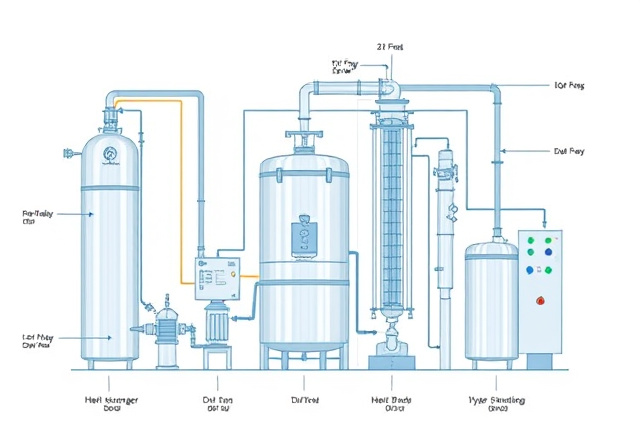
Generates a centrifugal force field to achieve deep dehydration and metal ion removal (< 1 ppm).
Increases mass transfer rate by 1-3 orders of magnitude.
Recycles latent heat efficiently, making the recovery of high-boiling NMP (202°C) economically viable.
Reduces energy consumption by 40-60% compared to conventional columns
Wide channels and high shear forces handle cleaning wastes containing slurry particles without fouling.
Continuous operation with high-solid content fluids.

From cathode coating to electrolyte filling, we provide total solvent management.

Recovery and purification of NMP from cathode slurry mixing and dryer exhaust condensate, reducing fresh NMP demand.
NMP Recovery
Cathode Coating
VOC Reduction

Recovery of solvents from black mass leaching, washing and purification streams in battery recycling plants.
Recycling
Black Mass
Resource Recovery

Treatment of solvent-rich off-gas condensates and scrubber liquids to reduce NMP/VOC emissions and recover solvent.
VOC Control
NMP
Emissions

Dehydration of NMP and carbonate solvents to very low water levels to meet battery-grade moisture specifications.
Dehydration
Low Moisture
Battery Grade

Reclamation of DMC, EMC, DEC, EC and PC from off-spec electrolyte, flushing solutions and blend changeovers.
Electrolyte
Solvent Reuse
OPEX Saving

Concentration and conditioning of lithium salt and fluoride-containing wastewater before further treatment or ZLD.
High-Salt
Fluoride
Wastewater
Solvent / Stream | Typical Source in Lithium Battery Manufacturing | Key Issues / Pollutants | VHPS Treatment Goal | Example Performance |
NMP coating exhaust & wash liquors | Cathode/anode coating and drying lines | High boiling point (202°C), high energy, moisture and metal ions | Recover electronic-grade NMP with low water/metals and lower energy use | NMP ≥ 99.95%; water ≤ 100 ppm; metals ≤ 1 ppm; energy use ↓ 40–60% |
Electrolyte carbonates (DMC/DEC/EMC) | Scrap electrolyte, off-spec electrolyte, flushing/flush batches | Moisture sensitivity, degradation, acid formation | Recover ultra-dry carbonate solvents without thermal decomposition | Purity ≥ 99.95%; water ≤ 10 ppm; acid ≤ 10 μg KOH/g |
Acetone (and mixed) cleaning solvents | Cleaning of coating machines, mixers, tanks and lines | Binder and powder solids, high COD, fouling of conventional towers | Regenerate cleaning solvent for reuse, remove solids and avoid clogging | Purity ≥ 99.5%; solids removed; reusable fraction ↑; COD to WWTP ↓ |
NMP-containing wastewater | Scrubber water, rinses and wash water with low NMP content | Low solvent concentration, high COD, discharge limits | Concentrate NMP, recover clean water for reuse or ZLD schemes | NMP concentrate ≥ 90%; volume reduction 50–80%; COD to WWTP reduced |
DMAC separator solvent loops | Battery separator manufacturing (wet-process) | High-boiling solvent, high energy, moisture control | Recover DMAC for internal reuse and control water content | DMAC ≥ 99.9%; water ≤ 200 ppm; energy use ↓ 30–50% |
High-salt / F⁻-containing process wastewater | Cathode active material, etching/cleaning and precursor processes | High TDS, fluorides (F⁻), scaling and difficult downstream treatment | Concentrate high-salt/HF streams and protect downstream evaporators/WWTP | Volume reduction 50–80%; improved treatability downstream |
Battery recycling black mass leach liquors | Black mass leaching and washing in Li-ion battery recycling | Dissolved metals, mixed solvents, high COD | Separate solvents from metal-rich liquor, enrich metals and recover solvents | High solvent recovery; metal concentration ↑; waste volume ↓ |
Acetonitrile & specialty electrolyte solvents | Formation/testing, electrolyte R&D and specialty formulations | Toxicity, high solvent cost, purity specs | Recover high-purity specialty solvents for reuse in battery production/R&D | Purity ≥ 99.5%; recovery ≥ 95–99%; fresh solvent consumption reduced |

Discover why industry leaders trust us to solve their most complex separation challenges.
Yes. VHPS hypergravity distillation is well suited for NMP recovery from mixer and dryer exhaust condensate, delivering high purity and high recovery while reducing VOC emissions and fresh NMP demand.
Yes. VHPS can treat LiPF₆ electrolyte streams and carbonate solvents with controlled temperature and pressure. Proper design helps manage moisture and HF risks while recovering valuable solvents.
In typical NMP and electrolyte solvent recovery service, VHPS heat-pump distillation can reduce energy use by about 30–50%, compared with conventional distillation or simple evaporation systems.
VHPS units are delivered as compact skids that connect to dryer condensate tanks, solvent storage, wastewater and electrolyte handling systems. This allows you to add recovery and treatment capacity with minimal disruption to existing production.