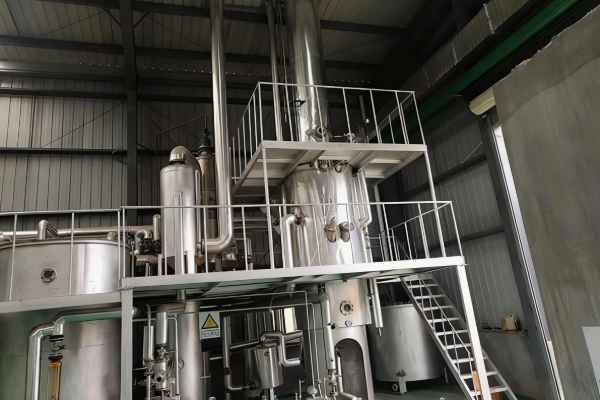
High-Salt Wastewater & Brines
Concentration of high-salt, high-COD wastewater and brines before biological treatment, crystallization or ZLD.
Industries:
High-Salt
COD Reduction
ZLD Prep
Extreme mass transfer forces strip volatile organics from water to ppm/ppb levels, far exceeding gravity-based strippers.
Achieves solvent recovery rates ≥ 95-99% from complex waste.
Makes solvent recovery economically viable by recycling latent heat, turning a cost center into a savings generator.
Reduces energy consumption by 40-60% compared to conventional columns
Wide flow channels and high shear forces prevent scaling and clogging, even with high-salt or solid-containing fluids.
Ideal for high-salt wastewater and landfill leachate concentration.

Transforming hazardous waste into reusable resources across industries.

Concentration of high-salt, high-COD wastewater and brines before biological treatment, crystallization or ZLD.
High-Salt
COD Reduction
ZLD Prep

Recovery of alcohols, ketones and polar solvents from process water and cleaning solutions for reuse.
Solvent Recovery
Wastewater
OPEX Saving

Stripping VOCs and odorous compounds from wastewater and off-gas to meet emission limits.
VOCs
Odor
Emissions

Concentration and partial purification of landfill leachate and mixed industrial effluents before final treatment.
Leachate
Pretreatment
Complex Streams

Recovery of solvents and organics from crystallization and process mother liquors before disposal.
Mother Liquors
Waste Reduction
Resource Recovery

Treatment of sludge dewatering liquors and high-load side streams to offload the main WWTP.
WWTP Relief
Utilities
Side Streams
Solvent / Stream | Typical Source in Environmental / Wastewater | Key Issues / Pollutants | VHPS Treatment Goal | Example Performance |
High-concentration organic wastewater (HCOW) | Chemical / pharma mother liquors and solvent-rich waste (5–50%) | Very high COD, solvent loss, expensive incineration | Recover solvent and reduce COD/volume before disposal or WWTP | Solvent recovery ≥ 95–99%; volume reduction 50–80% |
Chlorinated VOCs (DCM, TCE, etc.) | Electronic / chemical waste gas and wastewater | Toxic CVOCs, dioxin risk in thermal treatment | Low-temperature closed-loop recovery of CVOCs, avoid dioxin formation | Exhaust CVOCs < 10 ppm (typical); solvent reuse |
BTEX-contaminated wastewater | Petrochemical, pesticide, tank farm drainage | Toxic BTEX, inhibitory to biological treatment | Deep stripping of BTEX for safe discharge or bio-treatment | Outlet BTEX ≤ 5 ppm (typical); COD load reduced |
VOC absorbent oils / wash oils | Off-gas scrubbers, absorber oils, diesel wash loops | Saturated with VOCs, high viscosity, frequent replacement | Regenerate absorbent oil online, keep scrubber efficient and reduce waste oils | Regenerated oil VOCs ≤ 0.1%; reduced fresh oil consumption |
Waste acid / alkali with solvents | Resin, coating, chemical cleaning and neutralization streams | Mixed pH extremes, solvents, salts, high COD | Recover solvents and condition acid/alkali for safer downstream treatment | Solvent purity ≥ 99% (typical); COD reduction 30–60% |
RO/NF concentrate & high-salt brines | ZLD systems, chemical plants, industrial WWTP brine streams | High TDS, scaling risk, high disposal cost | Concentrate brine, reduce volume and protect downstream evaporators/crystallisers | Volume reduction 50–80%; scaling controlled |
Landfill leachate & concentrate | Municipal / industrial landfill leachate and RO concentrate | High COD, ammonia, salts, organic micro-pollutants | Pre-concentrate and condition leachate for downstream polishing or ZLD | Volume reduction ≥ 70%; COD reduction 30–50% |
Solvent-rich ETP / off-spec waste mixtures | Mixed chemical and pharma waste, ETP side streams | Mixed solvents, high COD, variable composition | Recover reusable solvent fraction and reduce hazardous waste volume | Solvent reuse fraction ↑; waste volume ↓ 30–50% |
Discover why industry leaders trust us to solve their most complex separation challenges.
Yes. VHPS uses high-turbulence hypergravity packing and can be designed with appropriate materials and cleaning strategies for high-salt, scaling-prone wastewater and brines, reducing fouling and extending run time between cleanings.
In typical high-COD, high-salt wastewater and solvent-rich effluent service, VHPS heat-pump distillation can cut energy use by about 30–50% compared with conventional multi-effect evaporators.
Yes. VHPS is well suited for solvent recovery and COD reduction from process water and cleaning solutions. You recover valuable organics for reuse while significantly reducing the load to your biological WWTP.
VHPS is usually installed as a compact side-stream or front-end skid connected to existing equalization tanks, stripping towers or evaporation trains. It pre-concentrates and pre-conditions wastewater, making it easier to reach discharge or ZLD targets without major civil works.